Read the water, weather, terrain, and living systems before placing the first road.
Simulation signal
World seed: Earth / 2026
 Nature & Nations
Raise a world.Leave a legacy.
A planet-scale city-builder & nature simulation
The world doesn’t reset — and neither do its people. Raise a civilization on a living, real-world Earth where families, choices, and consequences compound across centuries.
Coming 2026
PC · Steam
Single-player
Unreal Engine 5.8
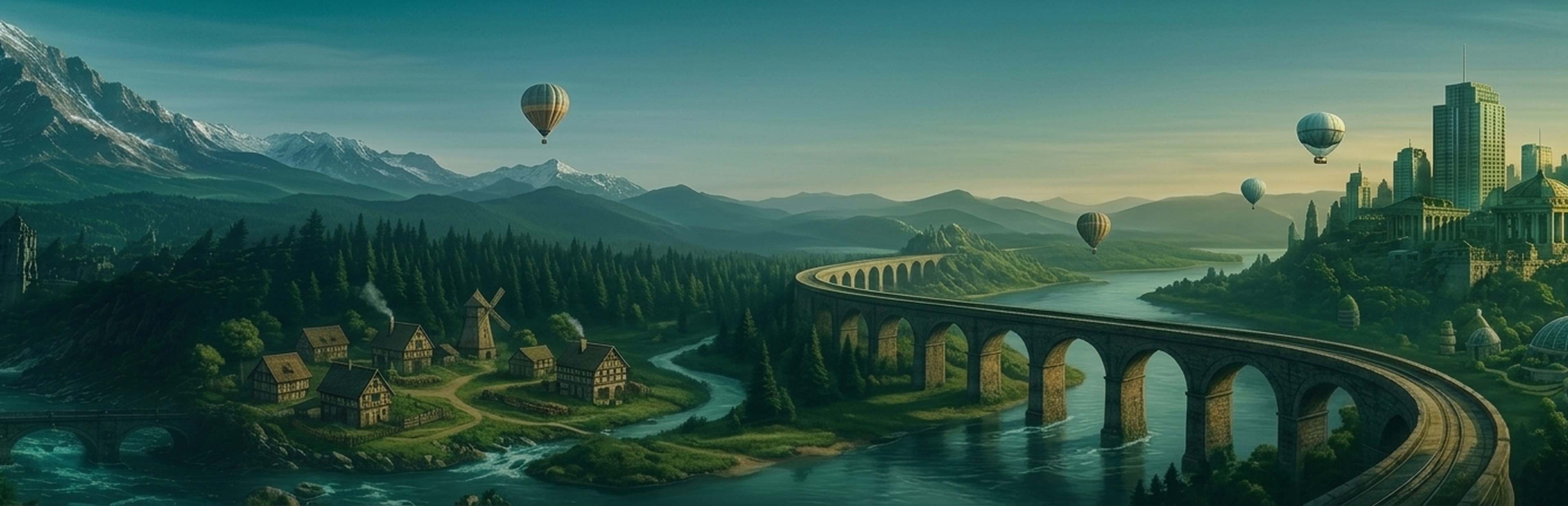 World vision / concept art
From first path to living nation
A century should feel like a journey.
A bridge is trade, access, pressure on a watershed, and a promise future citizens inherit.
Families, policies, ecosystems, and the skyline carry the evidence of a century of choices.
The Game
A whole world to build, and to keep.
Nature & Nations is a planet-scale city-builder and nature simulation. You found and grow communities — from a single hamlet to a nation — on a faithful model of the real Earth, where weather, water, ecology, and people all run on real forces.
It blends three games into one: the joy of a city-builder, the depth of a grand-strategy nation simulation, and the soul of a living ecology sim. Every choice ripples outward — from one street to the whole world — and the world remembers. Build well, tend faithfully, and watch a civilization rise; neglect it, and watch it groan. The world is alive whether you are watching or not.
What Makes It Different
Every life leaves a legacy.
Most city-builders forget. Nature & Nations remembers — people, choices, and consequences carry forward across generations, so every world grows a history that is truly its own.
Illustrative system previewOne watershed / one hundred years
Year / 100
Consequences emerge — they aren’t scripted
Underfund schools for a decade and watch it ripple outward through work, poverty, blight, and migration — a chain you can trace but never fully predict.
Your citizens are people, with families
They are born, raise children, and pass traits, wealth, and reputation down the line. Dynasties, companies, and rivalries persist for centuries.
Your city writes its own history
Headlines, milestones, and lives are recorded as they happen, so a hundred years on you remember the people and eras that shaped the skyline.
A Living Earth
The world is not a backdrop. It was here before you.
A whole planet, modeled on the real Earth — its mountains, coasts, climate, and sky, running on real forces rather than stagecraft.
Planet Scale
The whole Earth, from orbit to underfoot
Stand on real geography drawn from true elevation data, and rise from street level to the curve of the planet in one continuous sweep. Sculpt and shape the land — it remembers.
Weather & Seasons
A true global climate
Wind, pressure, and temperature flow from real atmospheric circulation. Storms form and travel; seasons turn with the tilt of the world; deserts, monsoons, and snow belong where they would on Earth.
Water & Sky
Rivers carved by the land, skies that turn
Water gathers where real elevation sends it — rivers run downhill, lakes fill basins. A real sun crosses the sky, clouds drift with the wind, and on the right nights the aurora answers to real space weather.
Living Ecology
Forests, grasslands, and the breath of the wind
Vegetation belongs to its biome, swaying in the very wind the weather drives. The living world fills the land you tend, and flourishes or fades by how you keep it.
The world’s biomes
Climate zones, from pole to equator
TaigaIn game
Vast boreal forests of spruce, pine, and fir — the first biome brought fully to life.
ArcticComing
Polar ice and permafrost at the ends of the Earth.
TundraComing
Cold, treeless plains of moss, lichen, and hardy shrubs.
Temperate ForestComing
Broadleaf woodlands turning through four full seasons.
Temperate GrasslandComing
Open prairies and rolling steppe.
DesertComing
Arid dunes and bare rock beneath a punishing sun.
SavannaComing
Tropical grasslands dotted with scattered trees.
Tropical RainforestComing
Dense, humid jungle teeming with life.
WetlandsComing
Marshes, swamps, and water-laced lowlands.
MountainComing
Alpine heights of bare rock and snow.
CoastalComing
The shifting edge where the land meets the sea.
OceanComing
The open water that covers most of the world.
Lush vegetation and wildlife are rolling out biome by biome — Taiga first.
Nature’s Fury
A world that can turn on you
The same living Earth that gives can also take. Real natural disasters strike where they would on the real planet — so a wise steward builds for them. They’re conveyed through warnings, stats, and overlays, never graphic harm.
Natural disasters
Geophysical
EarthquakePlanned
Ground shaking from fault movement that tests every structure.
VolcanoPlanned
Eruptions with lava, ashfall, lahars, and pyroclastic flows around volcanic terrain.
TsunamiPlanned
Long ocean waves that surge far inland after undersea quakes or slides.
Landslide / mudslidePlanned
Rock and saturated soil giving way down steep or sodden slopes.
AvalanchePlanned
A sudden release of snow and ice racing down mountain slopes.
SinkholePlanned
Ground collapse where rock or soil voids give way beneath the surface.
Hydrological
River floodPlanned
Rivers overrunning their banks across floodplains and towns.
Flash floodPlanned
Sudden, fast flooding from intense rain with little warning.
Coastal flood / storm surgePlanned
Storm-driven seawater pushing inland over the shoreline.
Meteorological
Hurricane / typhoonPlanned
Powerful rotating tropical cyclones bringing wind, rain, and surge.
TornadoPlanned
A violently rotating column carving a narrow path of damage.
DerechoPlanned
A long-lived windstorm of widespread straight-line gusts.
Bomb cyclonePlanned
A rapidly intensifying mid-latitude storm of wind and precipitation.
BlizzardPlanned
Heavy, wind-driven snow and whiteout conditions.
Ice stormPlanned
Freezing rain coating trees, power lines, and roads in ice.
HailstormPlanned
Storms dropping ice stones that batter crops and roofs.
Severe thunderstormPlanned
Intense storms with damaging wind and lightning.
Haboob / dust stormPlanned
Walls of wind-driven dust that swallow visibility and air quality.
Climatological
DroughtPlanned
Long water shortage stressing crops, reservoirs, and ecosystems.
HeatwavePlanned
Prolonged extreme heat straining health, power, and water.
Cold wave / polar vortexPlanned
Dangerous cold outbreaks that freeze and strain infrastructure.
WildfirePlanned
Fire spreading through forest, grassland, and the wildland-urban edge.
Atmospheric riverPlanned
A narrow plume of moisture delivering extreme rain or snow and floods.
Space weather
CME / geomagnetic stormPlanned
Solar plasma striking Earth’s field, disrupting grids, satellites, and radio.
Solar flarePlanned
A burst of solar radiation that scrambles communications.
Meteor / impactPlanned
A space object exploding overhead or striking the Earth.
Biological
Locust / pest swarmPlanned
Insect outbreaks stripping crops and stored food across regions.
Algal bloom / red tidePlanned
Toxic algae fouling water, killing marine life, and closing fisheries.
Disease epidemics are modeled separately as their own living system.
The People
Every person is a soul, not a statistic.
The people who fill your world are born, grow, age, and pass. They carry families, faces, faith, and frailty — and they respond to how they are treated.
Families & Lineage
Households form; bloodlines run deep
People pair, raise families, and pass their traits to their children. Follow a lineage across generations — the story of a place is the story of its families.
Faces & Bodies
No two people alike
Every person has a distinct, inherited face and body across the full range of real human variation. The crowd you walk through is genuinely a crowd of individuals.
Culture & Belief
Communities with their own way of life
Regions carry their own faiths, customs, and dress, blending across borders the way real cultures do. What a people values shapes how they live — and how they respond to you.
Mind & Wellbeing
People flourish — or they suffer
Crowding, neglect, and hardship weigh on people; safety, beauty, community, and care lift them. A city that looks prosperous can still be quietly breaking its people — and you will see it.
Build a Civilization
From a single street to a nation, you give the world its shape.
You don’t just place buildings. You found communities, name them, govern them, and watch them take on a life of their own.
Name Everything
Charter a hamlet; raise it to a nation
Draw the borders and give the names — hamlet, village, town, neighborhood, city, county, province, country. Every tier is yours to found and shape.
Zone & Shape
Decide how the land is used
Paint zones, subdivide land into lots, and set the character of each district. The world fills in around your intent.
Zoning types
Zone types — each at low, medium, or high density
ResidentialIn game
Homes and neighborhoods, from quiet streets to dense apartment blocks.
CommercialIn game
Shops, services, and the businesses that draw daily life.
IndustrialIn game
Factories, warehouses, and the productive backbone of a city.
OfficeIn game
Corporate and business-park workplaces.
InstitutionalIn game
Schools, hospitals, government, and civic life.
ParkIn game
Green space, recreation, and room for the city to breathe.
Mixed-useConfigurable
Shops below, homes above — configurable to combine any compatible zone types in the ratio you choose.
Architecture
Buildings raised, never copy-pasted
Structures are generated around their lot, building program, and architectural tradition, so cities feel grown rather than stamped out — with modular components expanding the procedural system.
The style library
Modern & global
ModernistIn game
Clean concrete, glass, and steel — the first style with full modular kit support.
Art DecoPlanned
Geometric setbacks, vertical lines, and the glamour of the early skyscraper age.
BrutalistPlanned
Bold raw-concrete forms, monumental and unadorned.
Contemporary High-RisePlanned
Glass-and-steel towers and curtain-wall skylines.
Europe
Gothic CastleIn dev
Pointed arches, defensive stone walls, steep roofs, and integrated towers.
BaroqueIn dev
Theatrical palaces, mansard roofs, central pavilions, and richly ordered facades.
European TraditionalIn dev
Human-scale masonry streets, old-world townhouses, and varied tiled rooflines.
Dutch Canal HouseIn dev
Slender brick canal houses with stepped, bell, and neck gables.
Byzantine & OrthodoxIn dev
Central domes, cruciform sacred plans, apses, and regional onion-dome variants.
Chalet & CabinIn dev
Program-aware Alpine homes, apartments, and lodges with snow-shedding gables, deep eaves, seeded facade rhythms, and supported balconies.
East Asia
Imperial ChinesePlanned
Sweeping tiled roofs, upturned eaves, bracketed timber halls, and pagodas.
JapanesePlanned
Timber homes and machiya, sliding screens, Zen temples, and tiered pagodas.
South & Southeast Asia
Indian & MughalPlanned
Domed Indo-Islamic palaces, carved jali screens, and soaring temple towers.
Southeast AsianPlanned
Stilted timber homes under steep thatch, and tiered temple spires.
Middle East & Mediterranean
Islamic & Middle EasternPlanned
Domes, minarets, pointed arches, and shaded courtyards behind mashrabiya screens.
Mediterranean SpanishIn dev
Program-aware villas, row houses, apartments, civic buildings, and hotels with round-arch reveals, low clay-tile roofs, supported arcades, and shaded porches.
Africa — Sahel & West Africa
Sudano-SahelianPlanned
Sculpted mudbrick mosques and civic buildings with buttressed walls, projecting timber beams, and monumental decorated facades.
Hausa / TubaliPlanned
Northern Nigerian and Nigerien earthen compounds with zaure entrance halls, vaulted or domed rooms, timber structure, and carved plaster reliefs.
Africa — North Africa & the Nile
Houch / Housh Courtyard CompoundPlanned
Djerban courtyard dwellings within family menzel estates — massive, introverted forms with few exterior openings and defensive corner towers.
Maghrebi Medina, Riad & DarPlanned
Dense lanes opening into private courtyard homes with shaded galleries, rooftop terraces, carved plaster, tile, and timber.
Ksar & KasbahPlanned
Fortified pre-Saharan earthen settlements and towered residences clustered compactly behind high defensive walls.
M’Zab & Saharan IbadiPlanned
Cubic houses arranged around fortress-mosques in fortified hill towns, joined to palm groves and carefully managed water systems.
Ghadamès Oasis HousePlanned
Vertically layered Libyan oasis homes above covered alleys, with storage below, family rooms above, and connected rooftop terraces.
Nubian & Nile Valley VernacularPlanned
Mudbrick compounds with barrel vaults, domes, shaded courtyards, sculpted entrances, and brightly painted facades.
Historic Cairo — Fatimid, Mamluk & OttomanPlanned
Mosque-madrasa complexes, pointed arches, carved minarets, sabils, mashrabiya screens, markets, and dense medieval lanes.
Coptic Monastic & ChurchPlanned
Basilican churches and desert monasteries with thick masonry, domed sanctuaries, enclosed courts, and fortified walls.
Ancient Egyptian MonumentalPlanned
Axial stone temples and tombs with pylons, columned courts, hypostyle halls, obelisks, and colossal gateways.
North America — homes & neighborhoods
Victorian Queen AnneIn dev
Asymmetrical homes with turrets, projecting bays, steep gables, dormers, and elaborate trim.
Classical Colonial & Colonial RevivalIn dev
Balanced facades, hipped roofs, dormers, pediments, and columned porticoes.
Storybook Revival & CottageIn dev
Detached and semi-detached cottages plus boutique inns, with ogee openings, steep seeded roofs, bellcast eaves, off-centre cross-gables, and upper-storey dormers.
Craftsman & Arts and CraftsPlanned
Low roofs, broad porches, exposed rafters, tapered piers, and honest wood-and-stone construction.
Prairie School & American FoursquarePlanned
Strong horizontal lines and sheltering eaves paired with efficient, boxy urban homes.
Cape Cod & New England ColonialPlanned
Compact timber homes with central chimneys, shingled walls, simple gables, and weather-shaped additions.
Shingle Style & Coastal ResortPlanned
Continuous wood-shingle skins, irregular silhouettes, broad porches, and rambling coastal massing.
Gothic Revival & Carpenter GothicPlanned
Pointed windows, steep gables, board-and-batten timber, decorative bargeboards, and church spires.
Tudor RevivalPlanned
Steep cross-gables, tall chimneys, masonry and stucco walls, and ornamental half-timbering.
Ranch & Mid-Century SuburbanPlanned
Long, low single-story homes with broad eaves, attached garages, and indoor-outdoor plans.
Brownstone & East Coast RowhousePlanned
Narrow attached homes, raised stoops, masonry facades, bay windows, and dense walkable blocks.
Shotgun & Creole CottagePlanned
Narrow Gulf Coast homes, shaded galleries, raised floors, tall openings, and climate-ready plans.
Second Empire & ItalianatePlanned
Mansard crowns, bracketed cornices, tall arched windows, cupolas, and ornate urban facades.
North America — the West & regional vernaculars
Western & Frontier VernacularPlanned
False-front main streets, timber porches, board-and-batten walls, ranch compounds, and railroad-town civic buildings.
Spanish Colonial & Mission RevivalPlanned
White stucco, red tile, arcades, courtyards, shaped parapets, and mission-inspired towers.
Pueblo Revival & Southwestern AdobePlanned
Stepped earthen masses, rounded walls, vigas, shaded portals, and desert-toned finishes.
National Park RusticPlanned
Oversized timber and local stone shaped into lodges that feel native to mountains and forests.
Pacific Northwest RegionalPlanned
Low sheltering roofs, exposed timber, deep glazing, and buildings nested into wet forest terrain.
EarthshipPlanned
Passive-solar, off-grid homes bermed into the earth and built from reclaimed materials.
North America — cities & civic landmarks
Greek Revival & Southern ClassicalPlanned
Temple-front porticoes, tall columns, strong cornices, and deep verandas adapted to heat.
Beaux-Arts & City BeautifulPlanned
Grand axial civic buildings, monumental stairs, domes, colonnades, and sculptural stonework.
Richardsonian RomanesquePlanned
Heavy rusticated stone, broad round arches, deeply recessed openings, and powerful corner towers.
Chicago SchoolPlanned
Early steel-frame towers with broad Chicago windows, masonry piers, and ordered street walls.
Canadian Château StylePlanned
Steep copper roofs, towers, dormers, and monumental stone railway hotels and civic landmarks.
Googie & Roadside AmericanaPlanned
Boomerangs, starbursts, cantilevers, neon, and optimistic space-age diners and motels.
Indigenous North America
Ancestral Puebloan & PuebloPlanned
Place-specific stone and adobe communities organized around plazas, terraces, and ceremonial spaces.
Haudenosaunee LonghousePlanned
Extended-family timber frames clad in bark, gathered into palisaded Woodlands communities.
Northwest Coast Cedar Plank HousePlanned
Monumental cedar post-and-beam houses with heavy plank walls and community-scale interiors.
Mandan, Hidatsa & Arikara EarthlodgePlanned
Circular timber-and-earth homes with central hearths and thick, climate-buffering envelopes.
Latin America & the Caribbean
MesoamericanPlanned
Stepped stone pyramids, plazas, palaces, and carved ceremonial platforms.
Fantasy & speculative
ElvenPlanned
Flowing, organic forms — grown more than built.
TreehousePlanned
Dwellings woven into the living canopy itself.
In dev marks a style with active procedural resolver or showroom work; final art and blending remain in progress. Planned styles form the broader library. Traditions will be procedurally blended, letting neighborhoods shift gradually and form regional hybrids where they meet.
Roads & Networks
Roads that flow like a real network
Lay roads that snap, curve, and connect with the ease of drawing a line — intersections resolve themselves, and lane markings follow real-world standards. And every road and path is fully customizable: set the lanes, sidewalks, medians, trees, and transit, then save your own configurations to reuse anywhere.
Country marking standards
Sourced designs
USAIn game
Yellow center lines with white lane dividers.
EuropeIn game
All-white markings with solid edge lines.
NetherlandsIn dev
White markings, “shark-teeth” (haaientanden) yield triangles, and signature red-asphalt cycle paths.
United KingdomIn game
Broken white center and lane lines.
ChinaIn game
Single yellow center with white lanes.
JapanIn game
White markings with regional lane patterns.
South KoreaIn game
White center and lanes with regional detailing.
IsraelIn game
White markings to the regional standard.
Middle EastIn game
White markings to the regional standard.
More countries — mapped to the closest design
CanadaUS style
North American yellow double center.
AustraliaEU style
White center markings.
GermanyEU style
White center markings.
BrazilAmericas
Single yellow center.
IndiaUK style
Dashed white center.
Road & lane types
Build the right street for the job
Vehicle roadIn game
Standard car-and-truck roads, from quiet lanes to multi-lane arterials.
Bike-only pathPlanned
A dedicated cycleway just for bicycles — the Dutch fietspad, often in red asphalt.
Cycle streetPlanned
A bikes-first street where cars are low-speed guests — the Dutch fietsstraat.
Pedestrian streetPlanned
A car-free zone for walkers and shopfronts — a voetgangersgebied.
Living street (woonerf)Planned
A shared, traffic-calmed street where people have priority and cars crawl.
Streetcar, bus & transit lanePlanned
Dedicated lanes that keep streetcars, buses, and rapid transit moving past the traffic.
Highway / expresswayPlanned
High-speed, limited-access routes with ramps and interchanges.
One-way roadPlanned
Single-direction streets for fast, orderly downtown grids.
Avenue / boulevardPlanned
Wide roads with planted medians and tree-lined sidewalks.
Alley / service lanePlanned
Narrow back-streets for access, deliveries, and parking.
Dirt / rural roadPlanned
Unpaved country roads for farmland and the frontier.
Every type is a starting point — reconfigure the lanes, sidewalks, medians, and surfaces to build your own.
Paths & Trails
Paths and trails for every way to roam
Beyond roads, lace the world with paths and trails — from city stairs and waterfront quays to backcountry singletrack. Each one places itself where it belongs, and every path is fully customizable to your own configuration.
Paths & trails
Trails — each placed by terrain & setting
Multi-use / shared-usePlanned
Wide paved paths for walkers and cyclists alike — parks, waterfronts, greenways.
Pedestrian footpathPlanned
Walking-only connections — gardens, plazas, neighborhoods, overlooks.
Nature / hiking trailPlanned
Natural-surface trails through wild habitat — forests, hills, mountains, preserves.
Promenade / esplanadePlanned
Broad formal strolling paths — seafronts, riverfronts, harbor districts.
BoardwalkPlanned
Elevated walkways over fragile ground — wetlands, marshes, dunes, beaches.
Equestrian / bridlewayPlanned
Horse-friendly trails — rural parks, grasslands, ranch country.
Golf-cart pathPlanned
Low-speed cart paths — golf courses, resorts, planned communities.
Gravel / unpavedPlanned
Rustic compacted paths — rural edges, river corridors, nature parks.
Singletrack (mountain bike)Planned
Narrow off-road bike trails — forested hills, bike parks, mountainsides.
Greenway / rail-trailPlanned
Linear corridors along old rail lines and river valleys, linking the map.
TowpathPlanned
Waterside paths along canals and navigations — locks, mills, heritage routes.
Nordic / ski trailPlanned
Groomed cross-country routes — snowy forests, meadows, mountain valleys.
Snowmobile trailPlanned
Signed winter motor routes across managed snow country.
ATV / off-road trailPlanned
Rugged motorized routes — off-road parks, deserts, service corridors.
Fire road / service trackPlanned
Wide access tracks for rangers and emergency vehicles — park interiors, wildfire country.
Accessible pathPlanned
Firm, gentle-grade routes for everyone — trailheads, overlooks, visitor centers.
Paths, steps & structures
StairsPlanned
Pedestrian steps that carry walkers up steep slopes and elevation changes.
QuayPlanned
A walkable waterfront edge along rivers, canals, and harbors — wider quays carry lanes too.
PierPlanned
An elevated deck reaching out over the water for strolling, fishing, and moorings.
Elevated walkway / footbridgePlanned
Raised crossings and bridges — including suspension and covered spans — over roads, rail, and water.
Pedestrian tunnel / underpassPlanned
Below-grade crossings that move people safely under busy roads.
Plaza / pedestrian squarePlanned
Open paved gathering spaces and car-free zones at the heart of a district.
CanalPlanned
Built waterways with walkable embankments threading through the city.
Surfaces, widths, and railings are yours to set — build and save your own path configurations.
Govern
Government that is alive
Nations can take any real form — and none is simply “good” or “evil.” Governments shift with their people, rise and fall, and can be reformed or overthrown. Set policy and taxes, and feel the consequences travel up and down.
Greenfield
The only light
Build the first and only civilization on an untouched world — just you, the land, and what you make of it.
Living Nations
A world alive around you
Share the Earth with rival nations that build, trade, scheme, and war on their own.
The Vision
A world meant to be felt, not explained.
We never put a meter on your screen for wonder. We build a world true and beautiful enough that you feel it on your own — and tune everything toward two things held together.
The first
Awe
The vastness and majesty — the feeling of being small before something ordered and beautiful beyond our making.
The second
Stewardship
The world is entrusted to you, not handed over to be used up. You live in it, not above it.
Held together, they make reverence — the care of someone who knows the garden is not their own.
Release
Coming 2026
The Steam page is being prepared. Ask for the link now and we’ll send it the moment wishlists open.
No signup form · you choose what to send
At launch
Windows
PC via Steam, built on Unreal Engine 5.8.
After launch
macOS
Mac support arrives following the Windows release.
Planned
Linux / Steam Deck
On the roadmap as the game grows.
After launch — the world in full. The base game is complete and rated Teen; nothing is held back. A later, optional, age-gated Realism expansion (ESRB Mature, 17+) will deepen the same living world with its harder dimensions — a deeper layer of the same world, for players who want it.
Built on Unreal Engine 5.8
Questions
Frequently asked
What is Nature & Nations?
A planet-scale city-builder and nature simulation. You raise civilizations on a living, real-world Earth and tend a world that responds to every choice you make.
What kind of game is it?
It blends a city-builder, a grand-strategy nation simulation, and a living ecology sim, built on Unreal Engine 5.8.
When does it release?
Nature & Nations is coming in 2026. The Steam page is not public yet; use the Steam alert on this page and we’ll send the link when wishlists open.
What platforms will it be on?
It launches on PC (Windows) via Steam, with macOS support after launch and Linux / Steam Deck planned.
Is it single-player?
Yes. Play Greenfield mode, building the only civilization on an untouched world, or Living Nations mode in a world of rival AI nations that trade, scheme, and war.
Does it use real Earth geography?
Yes. The world is modeled on the real Earth, with true terrain, climate, weather, and biomes from pole to equator.
How much will it cost?
Pricing will be announced closer to launch. Request the Steam alert here to catch the announcement.
Is more mature content or DLC planned?
The base game is rated Teen and complete on its own. After launch, an optional, age-gated Realism expansion (ESRB Mature, 17+) will add the harder dimensions of civilization for players who want them — the same systemic honesty, applied to weightier subjects. It’s a deeper layer of the same world, not a separate game.